
This section looks at driving tired...
I share my own experience - a situation that left me unhurt but lucky to be alive; I have some information about sleep - and a five part US video news report on the dangers of sleep deprived driving in young people.
In 1983 I moved my home and my business from London to Sussex.
Money was tight and so while building up my new business in Sussex I was still working a couple of days each week in London. This meant an early morning commute of about 70 miles and often long days, not finishing until late evening.
On one fateful evening I was heading home to Sussex at about 10.30pm after having been awake for around 16 hours. It was a wet night and almost dark when I first became aware that the car was not handling as well as it might.
I suspected a soft tyre on the rear nearside and stopped at a filling station to check; sure enough the tyre was soft and so I inflated it. All was well again, at least for a few miles.
When I was about 15 miles from home my eyelids began to get heavy. There was a 'sensible' voice in my head was telling me to "Stop and change the wheel"; but it was countered by a 'sleepy' voice saying "You'll be home soon – sort it in the morning".
Now of course it's easy with hindsight to realise that I should have changed the wheel – but even as an experienced driving professional with advanced driving certificates and lots of courses under my belt, I somehow managed to convince myself that the tyre change could wait until the next morning. My priority was to get home and to get some much needed sleep.
If you have tried to watch a TV programme when you were really tired you might have experienced a phenomena called 'micro-sleep'; this happens when your eyelids fall for the briefest moment and your head drops to one side immediately waking you up – probably less than a second elapses.
Micro-sleep is not usually a major problem at home, the biggest danger being that you will drop off and miss the end of your TV show – but when it happens behind the wheel it's a very different situation.
In my case it happened at around 50mph – a micro-sleep lasting less than a second.
As I realised what was happening and tried to correct the situation the poor handling due to the soft tyre sealed my fate. The car slammed into a high kerb pushing the front nearside wheel back about eighteen inches and buckling the car's shell – the car was a virtual write off. If the high kerb had not deflected the car it would have left the road and hit a tree – the consequence would probably have been 'no more me'. I was lucky, but there have been several tragedies where drivers have not had the same 'good fortune'.
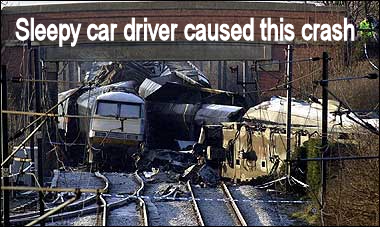 In 2001 Gary Hart survived a plunge onto a railway line when his Land Rover left the M62 motorway, but the crash caused the deaths of ten train passengers when a high speed train ploughed into the stranded vehicle (see image).
In Queensland, Australia it's estimated that driving while tired contributes to around one in six fatal crashes.
A study of long distance truck drivers carried out in 2001 in the USA found that 25% admitted falling asleep at the wheel in the previous year.
The UK Government 'THINK - campaign for road safety' states that an estimated that 300 people a year are killed in accidents where a driver has fallen asleep.
An article on Loughborough University sleep research centre web site states that most 'sleep' crashes involve male drivers and predominantly young males. The same article from goes on to say:
"Sleepiness affects the brain in subtle ways, for example, producing mild euphoria and impaired judgement of risk. This "buzz" of the small hours is why casinos open at night, as punters are more likely to feel lucky, and more likely to lose. It's another reason why driving without sleep in the small hours, when our "body clock" is also at its natural nadir, is the most likely time for these crashes."
Maybe I was 'feeling lucky' the night I crashed?
You may be pleased to hear that I no longer rely on good luck to keep me alive, nor should you.
Take precautions and heed the early warnings of tiredness. Bear in mind that being a good driver does not make you immune (I thought that I was a 'good driver'). Good driving is not simply a matter of skill and judgement; it requires a deep sense of social responsibility – something that I managed to overlook in 1983.
Sleep gives plenty of warning. And it's probable that you already know the signs!
- Difficulty concentrating
- Yawning
- Neck muscles relaxing
- Unintentional variations in driving speed
- Forgetting the last mile or two
- Daydreaming
- Realising that your reactions are slowing
- Sore or heavy eyes
- Dim or fuzzy vision
- 'Seeing' things (that aren't there)
- General tiredness
- Drifting across the road or on to 'rumble strips'
If you experience any of these symptoms while driving open your car windows and stop as soon as possible; on a motorway take the next exit or service area, whichever is closest; on a non-motorway stop at the first safe place.
Take a walk, or ideally a short sleep and then a walk. Caffeinated drinks will help but are not a substitute for other measures. It takes about twenty minutes for caffeine to affect your system, an ideal opportunity for a nap. But be aware that the 'caffeine/sleep' fix is a one off; if you start to tire again, break your journey and get some proper sleep.
If you realise your head is nodding or you drift out of lane – STOP! If you are on a motorway you might expect a prosecution for stopping illegally on the hard shoulder, but it's better than taking the risk of killing yourself and/or other road users.