
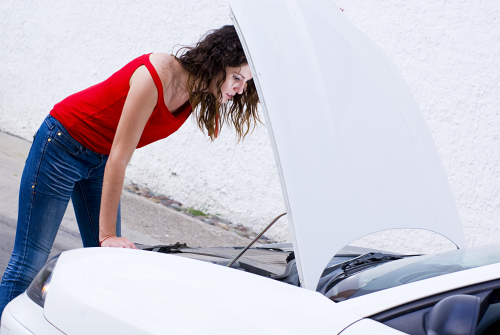
 We stress that the advice on this page is for general guidance only. Consult your vehicle handbook for detailed advice relating to your make and model.
If your car engine is sluggish when you turn the ignition key,or there is just a clicking sound, there is a good chance that you have a flat battery. The way to check is to switch on your headlights - if they are dim, or fail to work, the battery is flat.
You can 'bump' or tow start the car using the method explained below, however, you must be aware that this method can shorten the life of your catalytic converter, therefore, if you car doesn't start more or less straight away when you try to bump start, abandon the attempt (also, don't use this method repeatedly - get the car fixed!) - also you cannot 'bump start' a car with automatic transmission.
Push-Start (Bump-Start/Tow-Start):
With the ignition switched on and the handbrake released, select 2nd or 3rd gear and hold the clutch down. Tow, push, or allow the car to roll down a hill until you are doing 8 to 10mph and then engage the clutch briefly - the engine should start. You can do this with a 'bump' by engaging the clutch and then immediately disengaging it to allow you to 'rev' the engine. Note that this will not work for all cars in all situations (and not for automatics).
Perhaps a better method of starting is to use 'jumper leads'. However, before trying this, check the handbook to make sure that it is OK for your model - some engine management systems could be damaged using this method. Also ensure that the other vehicle operates at the same voltage (most cars use a 12v system, most trucks use 24v).
 Note that this method is not suitable for batteries where there is clear physical damage such as a crack - trying to jump damaged batteries can be extremely dangerous with a risk of explosion and will be pointless because the damaged battery will discharge within a minute or two of being charged.
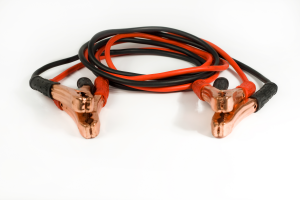
To connect two cars together in order to start them you will need a set of jumper (jump) leads. Jump leads are simply heavy duty cables with large 'crocodile' clips that are used to connect your battery to the battery of another vehicle. You should also wear safety goggles or spectacles to protect your eyes from sparks or in the unlikely event of battery damage - acid splashes.
First, turn all the accessory switches off on your car (radio, wipers, lights, screen heater, etc.); there are two reasons for this:
Check to see which side of the cars the batteries are situated on and then manoeuvre the car with the good battery to ensure that the batteries are as close together as possible allowing 'slack' in the jump-cables when they are attached. Make sure that the cars are not touching each other.
Connect the red leads:
Connect the red lead to the positive battery terminals of each car starting with the dead battery. The positive terminals will often have a red cover and be clearly marked with a plus sign (+). In older vehicles you might have to clean the terminals an area around them to see the + sign. Make sure that the leads make a good connection - you can do this by scraping the terminals to show bare metal.
The reason for connecting the red leads first (+) is to minimise the risk of a 'short circuit'.
Connect the black leads:
After you have connected the positive leads, connect the black negative leads. Start by connecting the black lead to the negative pole, marked with a minus sign (-) of the good battery and then to a bare metal part of the engine on the car with the flat battery (at least 45 centimetres from the battery for safety).
The reason that it is better to make the connection to a bare metal part of the car rather than directly to the battery is to minimise the risk from sparks around the battery itself which in extreme situations could lead to an explosion (due to the ignition of hydrogen released from the battery when it is charging). Although exploding batteries might be very rare the consequences are horrific (as they are filled with acid) if you do connect directly to the negative pole of the dead battery you should wear eye protection - just in case you are the 'one in a million'.
Expect that the leads may spark slightly when you attach them and be extra careful to make sure that the black lead clamps DO NOT come into contact with the red lead clamps or positive terminals of either battery.
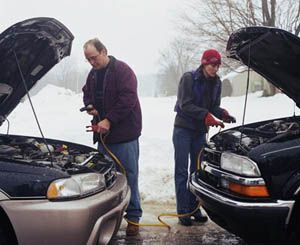 Start the engine of the car with the good battery and allow it to run for a few minutes to give the flat battery a charge. Then switch off the engine and remove the cables before starting the dead car - this minimises the risk of alternator damage (the alternator generates the electricity in your car).
Remove the cables as follows - remove the black lead from the 'dead' car first and then from the good car, being careful to keep the ends of the cables away from the red lead terminals. Then remove the red lead - first from the 'good battery' and then from the newly charged battery being careful not to touch any metal part of either vehicle when doing so.
If the dead car won't start it's likely that you didn't allow enough time for charging, if this is the case, repeat the process above making sure that the jump leads are making good, tight contact.
If the car still fails to start after a longer period of charging you can try starting the car with the leads attached and the other engine running. A clue that the battery is charging is that the car's instrument warning lights will start to come on as normal (ignition light, oil light, etcetera).
Allow the engine to run for a few minutes then switch off to see if it will start on its own. If not, the charging system is either not working at all or not working properly and the car might not get you home.
If you are unsure about what any of this means, DO NOT attempt a jump-start - call a breakdown mechanic.
Stay calm - stay safe!